
Program structure
The CDSB Operations Management program follows a flexible structured curriculum that gradually leads doctoral candidates from methodological training to independent doctoral research. Within the Operations Management program, students may specialize on predictive and prescriptive analytics. Doctoral candidates can build and extend their skills in areas such as mathematical optimization, stochastic modeling, simulation, data-driven decision-making, and machine learning.
The following exemplary study plan focuses on predictive and prescriptive analytics with i) core courses, ii) thesis-related courses, and iii) analytics-oriented electives. Core courses provide common methodological foundations in predictive and prescriptive analytics. The thesis-related courses closely support the early development of the doctoral candidate’s dissertation projects. They provide doctoral candidates with a structured environment to improve their scientific skills, for example through presenting and refining research ideas and receiving feedback from Operations faculty. This early integration of thesis-related courses is a key strength of the CDSB program in Operations Management, as it enables doctoral candidates to make substantial progress on their individual research from the beginning of the program. Based on specific research interest, analytics-oriented electives can be selected to cover state-of-the-art quantitative methods and allow doctoral candidates to focus on their doctoral dissertation.
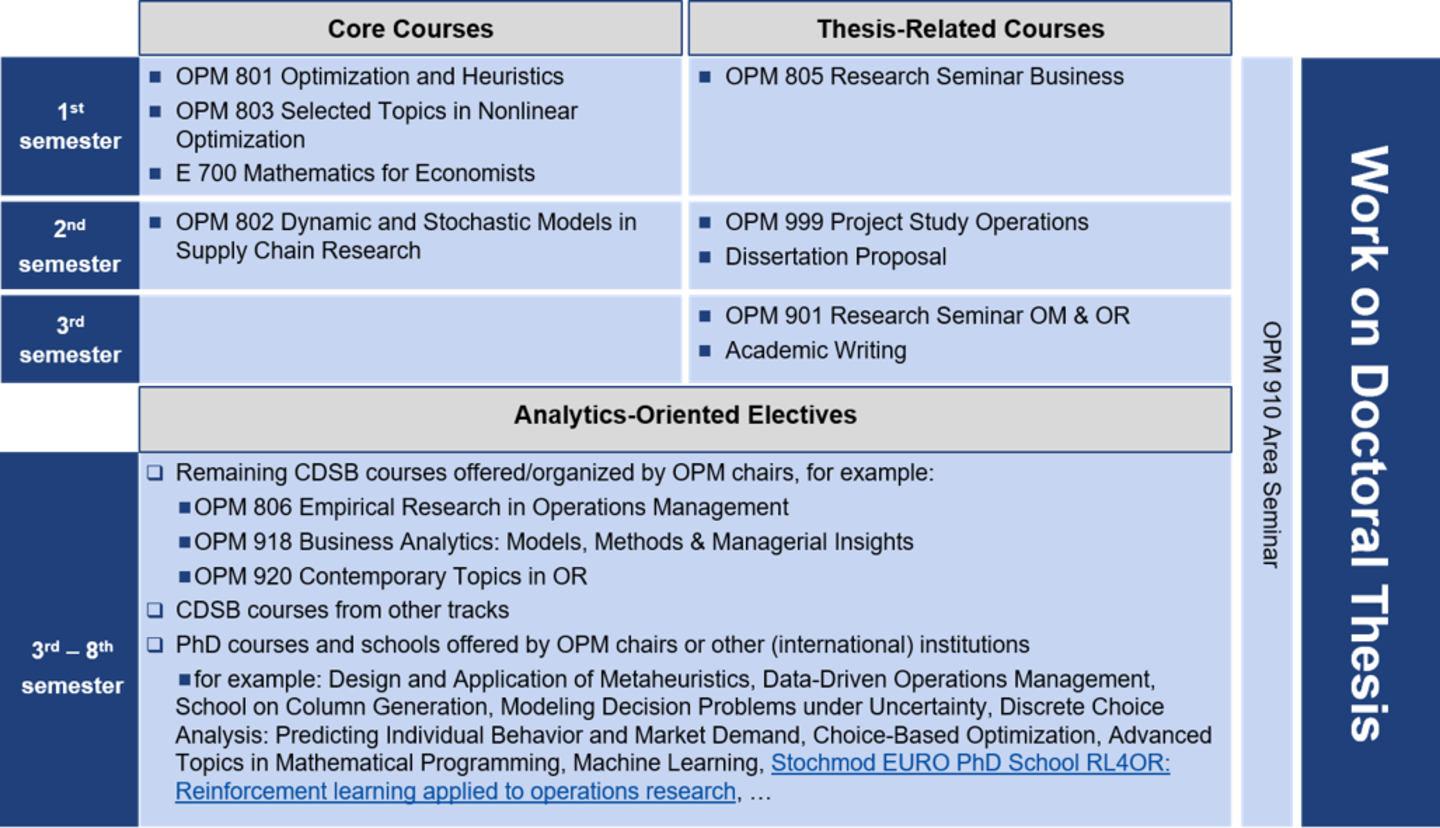
Many doctoral courses have a hands-on character, enabling doctoral candidates to translate analytical methods into research projects and managerial insights. Many courses are strongly connected to the Ph.D. project of the doctoral candidates to allow a quick start with own research. Throughout the program, doctoral candidates present and discuss their research in seminars, receive feedback from faculty and peers, and become part of an active research community.